English
 中文简体
中文简体 Español
 عربى
عربى
News
Home / News / Industry News / Compression Socks: Gradient Pressure Is Calculated in the Elastic Yarn Before Knitting
Content
Pull a compression sock over your foot and something very specific happens: the fabric grips the ankle harder than it grips the calf. That difference is the gradient, and it is the entire reason the garment exists. Ask most people where the gradient is created and they will point to the knitting machine or the finishing room. In practice, the pressure profile is largely decided much earlier, in the elastic yarn that is fed into the sock.
We spin, texture and cover yarns for a living, and the question we hear from sock makers is always a version of the same one: how do you reach the target pressure at the ankle without strangling the calf? The answer starts with a few yarn numbers that are fixed long before the first course is knitted.
Compression is measured in millimetres of mercury, and a sock is described by a band, such as 15-20 mmHg or 20-30 mmHg. That figure is the pressure at the narrowest point of the ankle. From there the pressure steps down as the leg widens: roughly 100 percent of the stated value at the ankle, around 70 to 80 percent at the mid-calf, and less again below the knee.
The gradient matters more than the headline number. If the calf holds the same pressure as the ankle, the sock restricts venous return instead of supporting it. If the drop is too steep, the sock slides down during wear. Both faults are usually blamed on the knit programme, yet both can begin with an elastic yarn whose recovery varies from package to package.
Pressure in a knitted tube follows a simple relationship: fabric tension divided by the radius of the limb. The knitting machine controls the geometry. The yarn controls how much tension it can hold and how reliably it returns to that tension after every stretch.
Elastic yarn brings two things to a compression sock. The first is immediate retractive force, which is the pressure you feel when you pull the sock on. The second is elastic recovery, which is the pressure that remains after a long day of wear and dozens of laundry cycles. A bare spandex core with stable recovery and a well-controlled cover gives the knitter a predictable platform. An inconsistent yarn pushes the knitter to compensate with tighter stitch lengths, and that is where comfort and durability begin to suffer.
When we review a compression programme with a customer, four yarn parameters come up again and again. The table below shows what each one actually influences in the finished sock.
| Yarn parameter | What it controls | Typical range |
|---|---|---|
| Bare spandex denier | Retractive force and fatigue resistance | 20D to 70D; 40D is common in 15-20 mmHg styles |
| Cover denier and filament count | Surface smoothness, dyeing consistency, hand feel | 2 x 20D/24F nylon, adjusted to the target sock weight |
| Covering method | Directional stretch, bulk, needle grip | Air covering is widely used in medical and sports styles |
| Draft ratio during covering | Elastic potential stored inside the finished yarn | Set by the spinner to match the target pressure band |
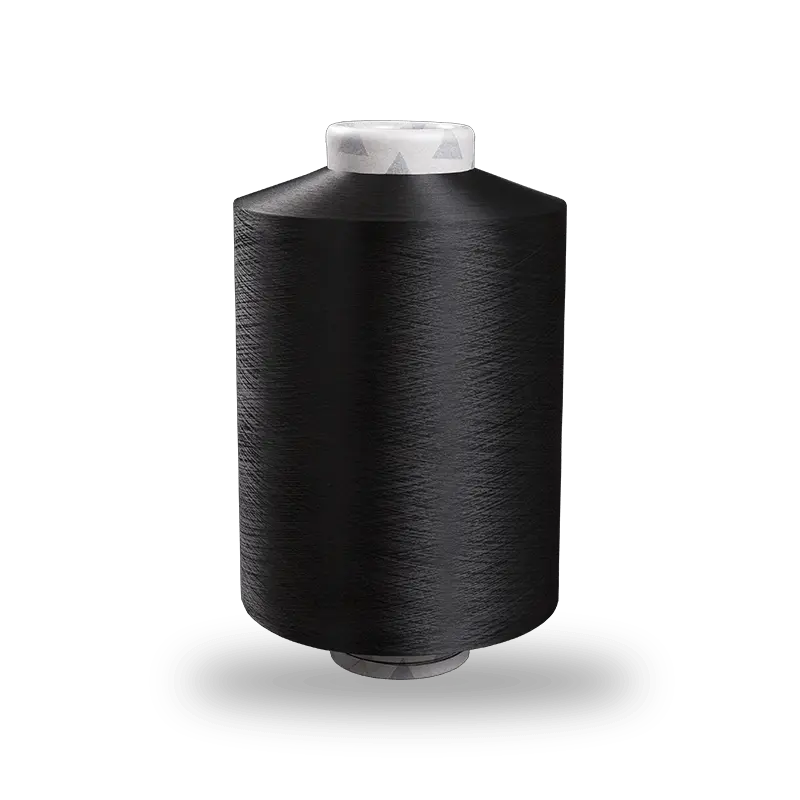
Air covering entangles a spandex core with textured nylon filaments using compressed air instead of a mechanical spindle. The result is a yarn with a softer and more even surface, stretch that behaves consistently in both directions, and fewer hard spots where the cover can slip and create a pressure spike.
For socks that must hold a pressure band after repeated washing and drying, that consistency is worth more than a marginal gain in raw elasticity. Mills that switch to a cheaper elastic yarn often discover the difference only after a wash test, when the socks no longer meet the labelled band. Our team has written a fuller technical note on air-covered spandex yarn properties and applications if you want the detail behind the specification.
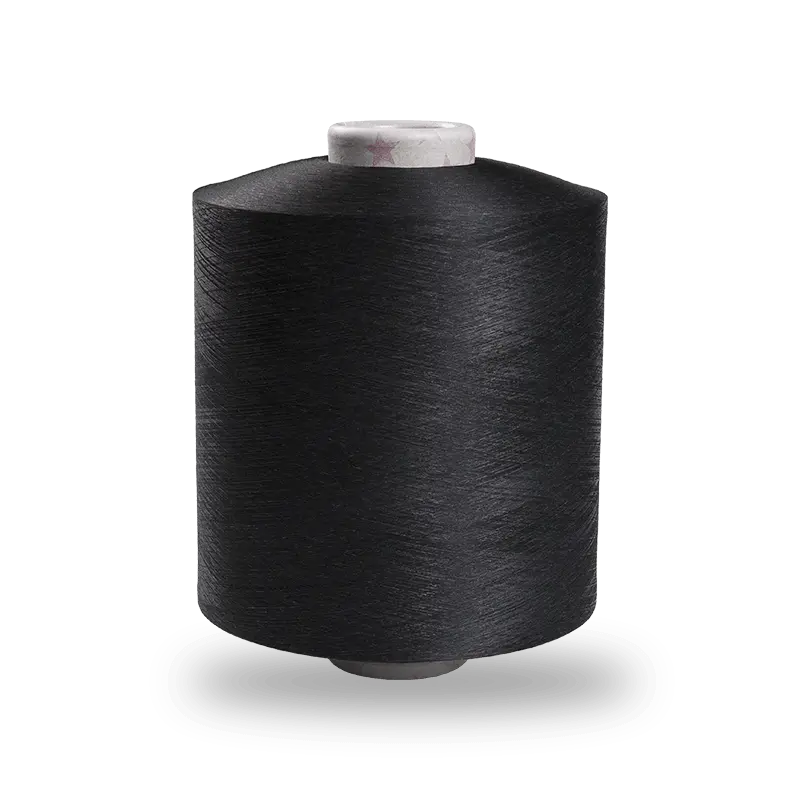 Spandex ACYCentury Chenxing mainly produces air-covered yarn. It is a yarn that uses outer fiber nylon filament and spandex yarn through a nozzle and uses air pressure to cover t...View Product →
Spandex supplies the pressure, but nylon supplies the sock. The body yarn decides how the sock feels, how it dyes, how quickly it dries and how long the surface survives abrasion inside a shoe. Two nylon forms do most of the work in compression constructions.
Draw-textured nylon brings bulk and crimp to the fabric, which is why it usually covers the leg and hides the elastic yarn underneath. In the foot, the same crimp gives terry loops their volume and softness. Intermingling level and evenness matter here, because a DTY with inconsistent nodes knits into visible bands that no amount of finishing will hide.
Fully drawn nylon has higher molecular orientation and a flatter, stronger profile. It is a common choice for the thin leg section where stability matters more than bulk, and for cuffs that must grip firmly without adding thickness under a trouser leg. Its lower friction also helps the sock slide over a dry heel in the morning.
Even a perfect elastic yarn only offers potential. What converts it into a measurable gradient is the knit programme: stitch length, elastic yarn feed tension, plating position and the number of needles working in each zone. A typical construction shortens the stitch slightly towards the ankle, or feeds the elastic yarn under tension that increases as the sock narrows.
This is why yarn and knitting specification deserve to be developed together. If a mill changes the elastic yarn without rechecking feed tension, the pressure band shifts even though the machine settings look identical on paper. The same thing happens after dyeing and relaxing, when residual shrinkage in the nylon cover quietly tightens the finished sock by a few millimetres of mercury.
Most problems we see in compression programmes trace back to a handful of recurring decisions:
Elastic yarn for medical and sports compression is not a commodity purchase, and it should not be sourced like one. Buyers need a spinner who understands what happens to the yarn after it leaves the package, and who can hold a specification across millions of metres.
Zhejiang Century ChenXing Fiber Technology has produced nylon filament and covered elastic yarns since 2017 from a 340-mu site with more than 1,000 employees. Our combined capacity reaches about 170,000 tonnes a year, covering nylon 6 POY, DTY and FDY, spandex covered yarns and short-staple spinning, with GRS certification and a provincial high-tech research and development centre behind our process work. For customers building gradient compression programmes, that vertical range means the core, the cover and the body yarn can all be matched before knitting begins. You can read more about our production base and quality system if you would like the full picture.
Gradient pressure looks like a finishing trick and behaves like a knitting decision, but it is calculated in the yarn first. Get the core denier, the cover and the recovery right, and the knitter has room to fine-tune the profile. Get them wrong, and no machine setting will save the sock. If you are developing a compression programme and want a second opinion on the yarn side of the equation, our technical team is always happy to talk through the numbers with you.
+86-(0)572-6295569
+86-193 5712 3632
# 1, Fuqian Street, Si'an Town, Changxing County, Huzhou City, Zhejiang Province, China.